
Knives Out, ideology, and truth

Rian Johnson’s recent film, Knives Out, is interesting because it’s a murder mystery that technically lacks a murder. That makes it, logically, simply a mystery. And what a mystery is, at its most basic, is an uncovering of the truth. The central question of Knives Out is thus the question, What is the truth?
For me, an even more interesting question to ask of the movie is, What is truth? Or even more pointedly, who or what constructs it?
This question becomes truly important when you consider the film as a commentary on the discourse surrounding immigration in the United States today. To me, Knives Out‘s political message is subtly pernicious. Not only does it promote the rewarding of individual virtue and hard work over a structural redistribution of wealth, it uses the genre of murder mystery to hide the role of ideology in shaping our perception of reality.

Many knives, much out
Knives Out‘s plot is as follows: Harlan, a famous author of murder mysteries, dies in an apparent suicide following his 85th birthday party. He leaves his considerable estate to Martha, his nurse who is a Latina immigrant. However, Martha believes that she fatally poisoned him by accidentally mixing up his medication, following which he committed suicide to protect her. Much of the film involves her trying to hide this fact from the investigating detectives.
[Spoiler: It turns out that Harlan’s grandson Ransom tampered with his medication in an attempt to frame Martha for his murder and steal the inheritance. As a result of his tampering, Martha’s supposed mix-up actually led her to administer the correct medication. In the end, there is no murder: Ransom’s foul play does not succeed, Martha is innocent, and Harlan killed himself not knowing he was perfectly healthy.]
The murder mystery has always been a genre which renders the role of the author invisible or ‘transparent’. The first half of Knives Out is a set piece exemplifying the murder mystery in its most generic form: a death has occurred, and the characters try to deceive a detective about what has really happened through their various accounts.
However, a greater deception is taking place on a formal level, that between author and reader. As you, the reader, step into the role of detective, you must remember that it’s not the characters whose deception you are up against, but that of the author. It’s too easy to get caught up in the characters’ accounts and forget your true adversary: the authorial force selectively editing and presenting you with information.
Knives Out is acutely aware of this slippage between author and characters, between reader and detective. The film self-consciously plays with tropes like the secluded mansion, the dysfunctional family backstabbing each other over an inheritance, and the eccentric detective. It’s first and foremost a genre film, which is basically Rian Johnson’s thing.

In Go, unlike Chess, it’s much harder to codify a winning strategy
However, another way in which the film makes this slippage apparent is through its repeated emphasis on the motif of games. The game of Go is what ties Harlan, Martha, and Ransom together. It’s also directly linked to the game of outwitting the detectives, making the three characters occupy similar roles in “authoring” the narrative. Out of the three, Harlan most clearly inhabits this role, his profession as famous murder mystery author foregrounded from the beginning. One of Martha’s defining characteristics is her ability to consistently outwit him at Go, as seen directly before his death. Ransom then takes their shared propensity for Go and turns it into a persuasive proposition that they buddy up to outwit the authorities, thereby assuming the role of authors who outwit their readers.
Yet, tellingly, Martha is described as winning her rightful inheritance by playing the “game” of the murder mystery not by Harlan’s rules, but by her own rules. As she explains to him, she plays not to win, but out of a desire to build a beautiful pattern with the pieces. There is a complete lack of disingenuity, a pure and unmotivated goodness, to her actions. Later, the detective Blanc explains to her that her self-sacrificial nature in saving Fran’s life rather than preserving her alibi is what allows to “win the game”, as her innocence emerges and she keeps the inheritance.
As such, what does Martha playing by her own rules consist of? As a character, Martha essentially has two identifying traits: goodness and honesty. By treating goodness and honesty interchangeably, Johnson conducts a sleight-of-hand that allows him to present the film’s central message: that the truth will come to light and (directly, interchangeably) goodness will be rewarded.

Martha, too, makes me want to barf
Johnson goes to great lengths to make Martha’s honesty unquestionable. He naturalizes it as a physical trait; she spews chunks of vomit every time she so much as thinks about telling a lie. Just as her goodness doesn’t allow her to play the game, so does her honesty. The authorial role is thus reversed; rather than deliberately concealing the truth from the reader, she reveals it (though, like the oracle Cassandra, this revelation may be partial, or misleading). Martha wants to tell the truth; she is only limited by her own incomplete knowledge of events. In fact, at the end of the film, it’s revealed that she didn’t have to lie at all. The truth has come out, and it has acquitted her. The hole at the centre of the donut hole, as Blanc puts it, is the movie’s illusory absence of an author.
Through the character of Martha, Johnson indirectly transforms the role of the author from constructing the truth, to merely acting as the conduit for a truth that will inevitably out itself. The truth is portrayed not just as objective, but inherently moral; through its revelation, the good receive their just reward. But what is this “objective” truth that Johnson portrays as ultimately emerging? The truth asserted here is that unlike Harlan’s greedy and grasping descendants, Martha has earned his wealth fair and square. That’s the whole point of the mystery, this seemingly unnecessary complication that diverts the course of the truth. It allows Martha to prove the moral dimension of the truth of events, by demonstrating the goodness that made Harlan’s worthy heir. And it’s when truth is presented as being unquestionable and objective that ideology quietly sneaks in unobserved.
The theme of immigration and wealth inequality simmers under the skin of the film from the beginning, emerging more fully in a (somewhat clumsily injected) scene where Harlan’s children and grandchildren participate in a xenophobic argument at his birthday party. In this moral drama, Harlan represents the self-made man. His children and grandchildren are caricatures of America’s monied social elite, blind to the tremendous advantages their inherited wealth has given them as they insist that they too are self-made. Martha represents the literal immigrant in their familial home. While on the surface they are kind to her, they turn on her the moment she threatens to usurp all that they have.
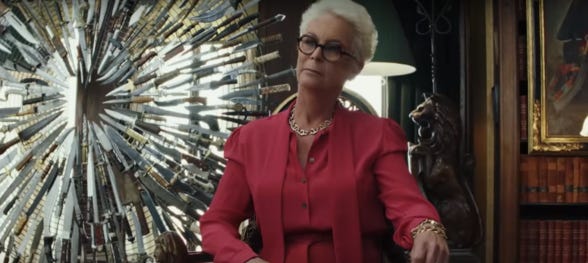
Just a “small loan of a million dollars” from dad
My issues with the moral message of the film are several. It portrays Martha as Harlan’s heir and therefore his equal due to her hard work. In doing so, it ignores the structural causes of discrimination against immigrants and instead privatizes them to the realm of personal responsibility, placing the onus upon the individual to pull herself up by her bootstraps.
In many ways, the myth of the self-made man simply does not realistically exist today, especially not for immigrant families. It’s telling that the film resorts to an act of benevolence by a single eccentric individual to resolve the tremendous inequalities visible in the film. If Harlan had not died, could Martha have ever hoped to attain his level of wealth by working for him as his nurse, even if he lived for another few decades? In an age of ultra-billionaires, the mega rich often seek to justify their obscene wealth through sporadic acts of philanthropy, rather than acts that would concretely redistribute wealth to their workers, such as paying their taxes or providing humane wages. These workers are often easy to exploit precisely because they are societally marginal, for reasons such as their immigration status.
Martha is portrayed as deserving this spectacular windfall as an individual because she is exemplary in every way. She is good, she is kind, she is honest to the point that thinking about lying makes her projectile vomit. The film uses her to complicate the narrative of good immigrant/bad immigrant on a superficial sense; Harlan’s son berates illegal immigrants as lazy and thieving and calls her a ‘good’ immigrant as she smiles uneasily, all too aware that her mother is an illegal immigrant herself. A far more radical act would have been to throw away this dichotomy of goodness or badness altogether. Immigrants shouldn’t have to earn a better life by being literal angels, but simply by virtue of the fact that they’re human beings.
The film ends with Martha having stepped seamlessly into Harlan’s shoes. Wearing a throw around her shoulders, she stands on the balcony that now belongs to her, holding his mug, gazing down on his suddenly disenfranchised descendants. It’s a delicious scene which Johnson milks for the maximum amount of feel-good sentiment. Suddenly, the underdog is literally elevated; suddenly, the former high and mighty are underfoot. Until this point, Martha is portrayed as oscillating between two choices presented to her – whether to keep all the money for herself, or to use it to help Harlan’s family. While the film implies that she chooses not to help them, what’s more important is the author’s invisible hand in restricting the viewer’s imaginative possibilities as to what Martha can possibly do with that wealth. Having fluidly become Harlan, she is only allowed one of two roles: that of the ultra-rich wealth hoarder, or the sentimentally-motivated sporadic benefactor.
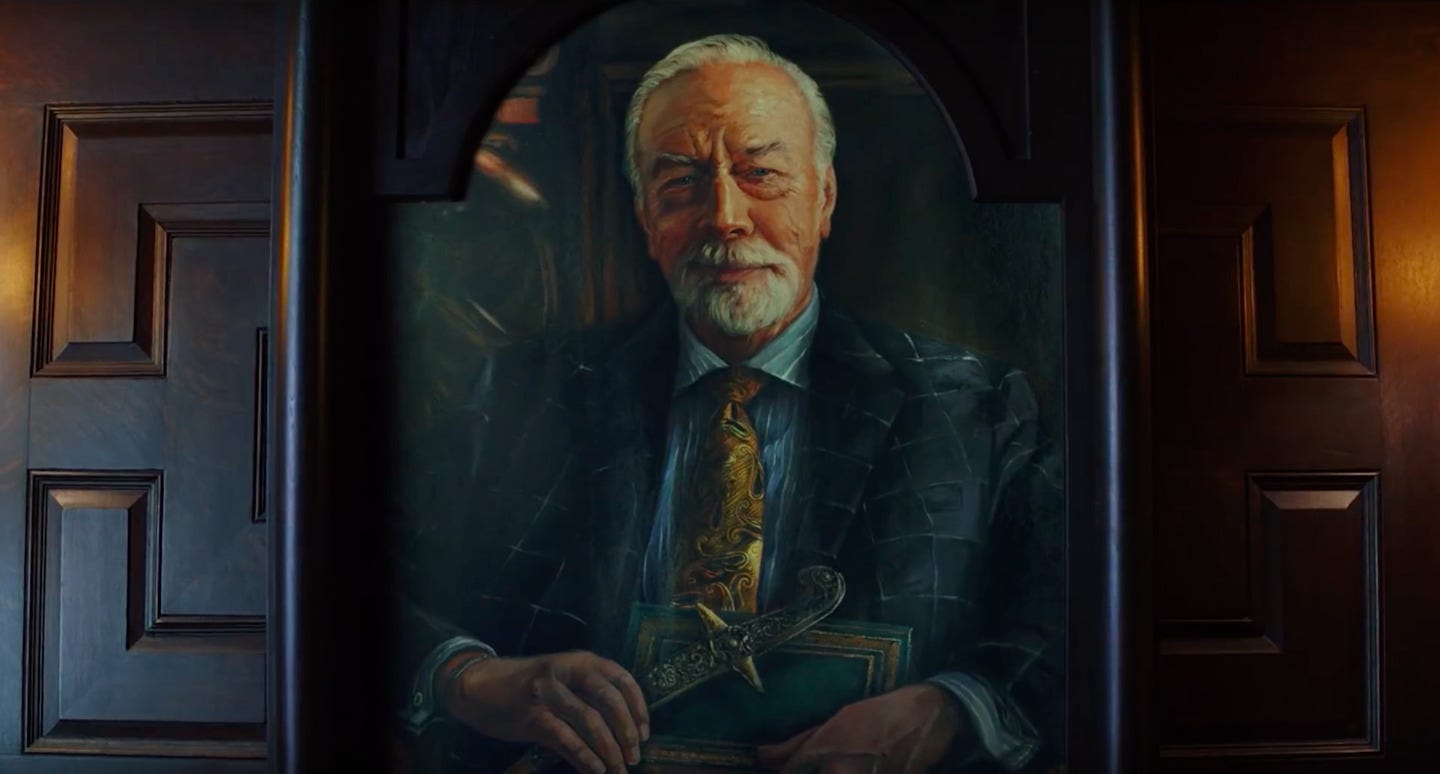
The spectre of the self-made man?
In Capitalist Realism (which I just read – look out for my next post on it!), Mark Fisher writes that contemporary media is no longer able to imagine concrete alternatives to capitalism. He writes compellingly about how, by presenting capitalism as “real” or natural, we fail to question the historically specific forces that construct current society. Instead, the only solutions offered to the problems of capitalism are solutions that continue to operate within capitalism itself. He also cites Žižek, arguing that films that get us to intellectually and emotionally reject the dangers of capitalism don’t actually get us to question the way our actions are complicit through participation.
Knives Out is a fascinating example of capitalist realism because of the manner in which it seemingly tackles the subject of the real, yet neatly evades it. Its post-modern self-consciousness of genre and narrative suggests a conception of the truth as constructed. Yet its version of the truth is disappointingly simplistic, singular, and moralizing.
In the end, the film is nothing but a prop knife like the one Martha is stabbed with. What appears initially to be pointed and cutting is nothing but a fake-out. The only thing it’s enabled is the self-made man to die by his own hand, his death preceding all narrative and leaving behind an undead spectre that we with our prop knives are unable to kill.